
The Third State
Information-Theoretic Death and the Limits of Traditional Categories

Summary
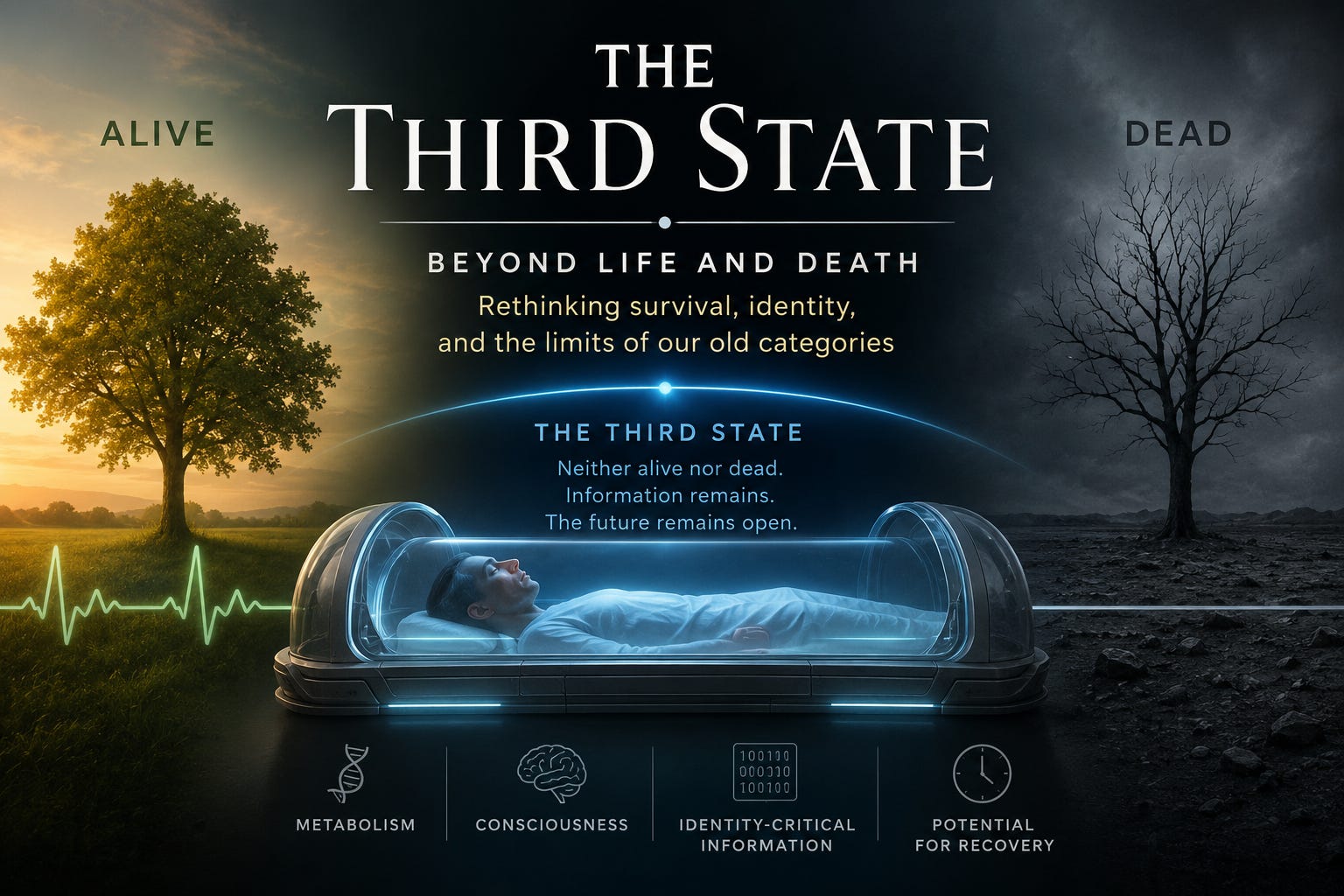
Our inherited vocabulary is like an old map. Every map leaves something out. As explorers discover new lands, the map must be redrawn. The same is true of our conceptual maps. For centuries, medicine divided people into just two territories: alive and dead. Biostasis reveals that the landscape is richer than that. Between those familiar regions lies another territory—one our inherited vocabulary never anticipated. People involved in cryonics have been thinking about this for decades and have come up with a range of candidate terms and concepts. Among the terms referring to a person in the third state are deanimated, inactivated, in a biostatic coma, in an ametabolic coma, suspended, preserved, in stasis. Yet more options come to mind. Which terms should we prefer and why?
Importance of Terminology
When we talk about patients in biostasis we are referring to something that does not fit existing, recognized categories. Our vocabulary is inherited furniture. Most of the time it serves us well. But every so often science builds a new room, and suddenly none of the old furniture fits. The difficulty of naming biostasis patients may itself be evidence that we are encountering a genuinely new category that inherited language was never designed to describe. This is a case of scientific and technical developments revealing the need for new categories. The history of science is littered with conceptual potholes dug by bad terminology. The right word can make a concept seem natural; the wrong word can make it seem strange or misleading.
If we talk about cryonics and biostasis without challenging existing categories, we will run into problems including lack of comprehension and resistance. To illustrate the point, consider some analogous examples.
Biostasis has not created a new state of being. It has revealed one that always existed conceptually but could not be recognized until medicine advanced far enough to preserve the structures underlying personal identity.
Survival of the fittest: This term is unfortunate and has led to confusion and misunderstanding. To most people, “fittest” means strongest, fastest, most aggressive. But in evolutionary biology it means organisms that leave the most descendants. An organism can be physically weak and still be evolutionarily “fit.” The phrase has contributed to misunderstandings of evolution and even to misguided social and political doctrines – misunderstandings that have persisted for many decades.
The Big Bang: This brings to mind a huge bomb exploding into empty space. The term was coined derisively by Fred Hoyle but caught on in common usage. The image is misleading because cosmologists are not talking about an explosion in space. They are talking about an expansion of space itself.
Brain death: In this case it is not so much that the term is confusing, although it was when first introduced. Many people found it contradictory: How can someone be dead if their heart is beating? The term forced medicine and the public to rethink what death actually means. That makes it a good parallel to terms describing the third state.
Left vs. right: Political thinking and understanding have long been distorted by use of the simplistic, one-dimensional left/right spectrum. This distinction originated in late 18th century France where the supporters of the king sat to the president’s right and supporters of revolutionary change sat to the left. As political thought evolved, however, it became increasingly clear that one dimension could not adequately describe all political philosophies.
Imagine trying to describe every location on Earth using only latitude. Entire continents disappear into a single number. The traditional life-death distinction similarly compresses metabolism, consciousness, and informational integrity into one dimension. The third state functions like a bridge suspended across time. Traffic has stopped, but the structure remains intact, waiting for travel to resume.
The left-right spectrum did not become false; it became incomplete.
The Nolan Chart plotted political views along two dimensions: economic freedom and personal freedom. This new representation made sense of how “extreme” left and “extreme” right views can look similar in outcome. It also makes room for views like classical liberalism and libertarianism which never fit into the left/right spectrum and yet is a consistent view.
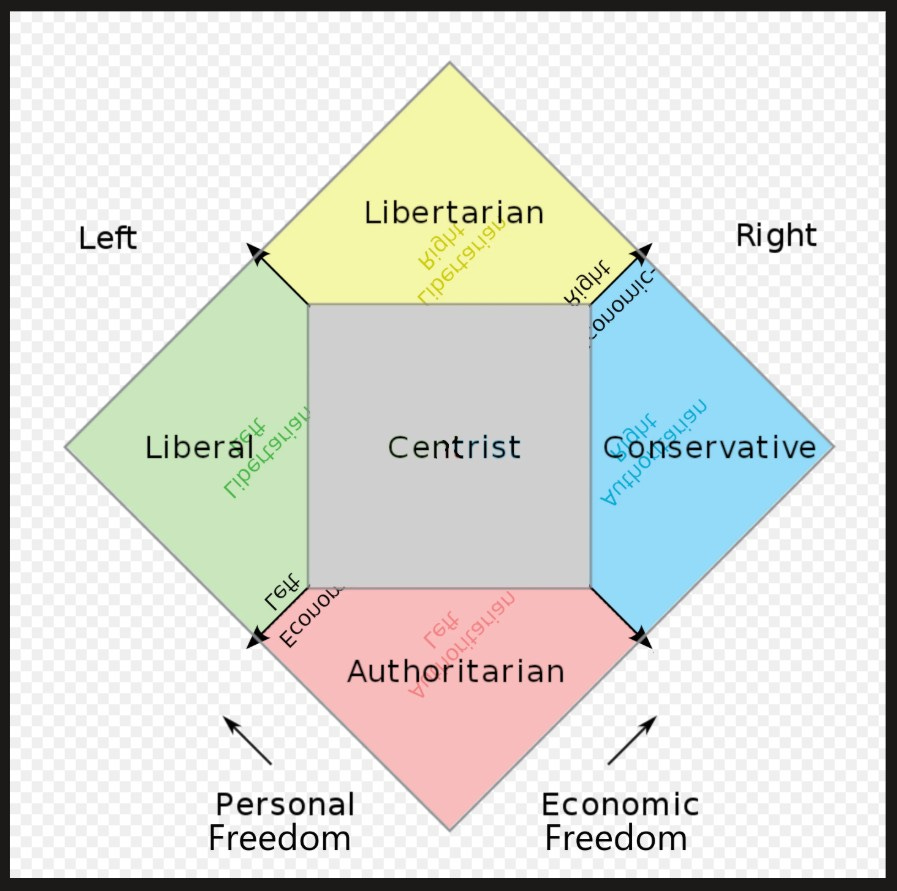
The left-right spectrum did not become false; it became incomplete. By collapsing multiple dimensions into one, it obscured important distinctions. The traditional life-death dichotomy may suffer from the same limitation. It compresses several independent variables—metabolism, consciousness, and preservation of identity-critical information—into a single binary classification.
Analogies
The introduction of the third state is not a unique phenomenon. Plenty of analogous cases illustrate the point that improved understanding of the world sometimes requires new categories. Briefly, here are three of them.
States of matter: Ancient and early modern thinkers recognized three familiar states: solid, liquid, gas. Nature turned out to be more complicated. Plasma did not fit the old categories, and eventually physicists expanded their framework. Modern physics recognizes many additional states or phases: superfluids, superconductors, Bose-Einstein condensates, quark-gluon plasma, liquid crystals, and others.
Classification systems should follow reality rather than tradition.
Likewise, we have traditionally divided people into only two states: alive and dead. Biostasis may reveal a third condition that fits neither category. Categories should be tailored to reality, not reality squeezed into inherited categories. Few analogies are exact. In this case you could argue that the additional states of matter are still all forms of matter. We could reply that life, death, and the third state are all forms of biological organization. Regardless, the analogy works primarily as a lesson about taxonomy and conceptual evolution, not as a direct physical parallel.
Legal status: Historically, people were classified as either citizen or foreigner. Eventually societies created intermediate categories: permanent resident, protected person, refugee, dual citizen, stateless person. These new categories reflected important practical and political considerations.
Information: Given this essay’s concern with information-theoretic death and the third state, this is probably the most direct analogy. A computer can be (a) running; (b) permanently destroyed; or (c) powered off but retaining all of its information. Nobody confuses the third condition with the second. The machine is not operating, but neither is its information lost. Biostasis advocates would argue that a cryopreserved person occupies an analogous condition: inactive but information-preserved. Critics may object that people are not computers, but the analogy gets directly at the central issue: preservation versus destruction of information.
Language Suggestions from 1983, 1988, and 1991
The “third state” seems to have been first used by Mike Darwin in a 1983 Cryonics article, but while the concept continued, the term was largely forgotten. I used the term in a 1991 Cryonics magazine article titled “The Third State.” In that piece, I argued that biostasis shines a light through cracks that have always existed in our categories but were previously invisible. The traditional classification of alive or dead was explained by the fact (until the mid-20th century) that “when heartbeat and respiration stopped there was no way to return a person to life. It seemed that there was a point beyond which life had permanently ceased, and so it was natural to assume that life suddenly turned into death.” Widespread belief in a non-physical “soul” also made it seem natural to understand death as the point at which the soul left the body—a sudden event rather than a gradual process.
I continued: “Dying can no longer be thought of as a sudden event. Since the personality is encoded in the structure of the brain, dying is a gradual process of degradation in the neural structures embodying personality. The possibility of halting the dying process demands a new term to describe the condition of someone in the stages between the first state of normal conscious function and the second state of death. This Third State (in historical, not logical order) is the condition cryonic suspension patients are in.”
An important piece of writing that dealt carefully with this terminological and philosophical issue was Brian Wowk’s 1988 article, “The Death of ‘Death’ in Cryonics.” Brian articulated a point now widely accepted among biostasis advocates: “Death: the absolute and irreversible loss of life, which occurs in human beings when their brain structure is destroyed.” It was common at that time and for decades after to refer to biostasis patients as “deanimated.” Brian suggested alternatives: “In an ametabolic coma” or “biostatic coma.”
In the debate following Brian’s article, Jerry Leaf and Hugh Hixon rejected Brian’s suggestion that we refer to suspension patients as being in an “ametabolic coma” or in an “ischemic coma,” on the grounds that these terms already have defined senses incompatible with our desired usage.
That was my motivation for suggesting “inactivate” – an absence of biological activity. That term did not catch on – for understandable reasons – and most cryonicists continued to use “deanimated” or “suspended.” (It would have been better to suggest “inactivated” since saying someone ‘is inactivate’ sounds awkward.)
Can we do better?
Another Use of “Third State”
To avoid confusion, I will note that there is another, quite different use of “the third state” in biology. It is not clear how widely this has been adopted but it is worth mentioning. In this usage the “third state” describes a condition where cells of a deceased organism continue to function and even acquire new capabilities after death. Researchers Peter Noble and Alex Pozhitkov found that certain cells, when provided with nutrients, oxygen, or biochemical signals, can reorganize into new multicellular forms called xenobots or anthrobots, exhibiting behaviors like movement, self-repair, and limited replication beyond their original biological roles.
In other words, the third state is where life persists after death at the cellular level. This differs importantly from my use of the term which refers to the state of the entire organism (or at least the brain). Some collections of cells may persist after the person has died but that in no way means that the person has not died.
The Third State and Information-Theoretic Death
The relationship between the third state and Information-theoretic death may be clear to most readers but I will make it explicit.
We inherited a picture of death as a light switch. Information-theoretic death suggests something closer to a dimmer switch. Or a symphony stored on paper which is silent but has not ceased to exist. Silence is not destruction.
Information-theoretic death is a concept primarily used in biostasis and neuroscience to define death in terms of the irreversible loss of information stored in the brain, rather than the cessation of biological functions like heartbeat or respiration. Information-theoretic death occurs when the brain’s structures encoding memory, personality, and cognition are irreversibly destroyed, making recovery of the original mind impossible, even with any physically possible future technology.
People in the third state – if they have been preserved sufficiently well – possess informational integrity and continuity. They occupy conceptual territory that medicine only recently discovered. Information-theoretic death will be avoided so long as the person is kept in the third state until technology is available to revive them. People in the third state are not alive because they have no metabolism. They are not dead because the structures in their brain still encode personal identity-critical information. The third state functions like a bridge suspended across time. Traffic has stopped, but the structure remains intact, waiting for travel to resume.
The Third State is not one condition but a family of conditions united by the preservation of identity-critical information.
Strictly speaking, the Third State is a collection of states, all of which preserve identity-critical information. The term “biostasis” itself covers more than one possibility. Until recently, it has been almost exclusively used to refer to cryopreserved people. We could distinguish between cryopreservation without concentrated cryoprotectants from vitrified patients but this is not a major conceptual distinction. Besides biostasis, informational continuity could be preserved through chemical fixation such as current methods relying on glutaraldehyde.
The third state also encompasses the preservation of one’s identity-critical information in digital form. The most obvious scenario is to use this information to create a brain emulation. So long as you agree with some form of functionalism in the philosophy of mind, this allows for personal continuity without biology.
A less discussed possibility is to use the digital information to grow a new brain containing all the memories and personalities of the person from which the information was extracted. Someone existing in the form of stored information would not be dead, since there would be no irreversible loss of the information necessary to restore function.
How to Describe Someone in the Third State?
Inactivate(d): In my 1991 article, I suggested “inactivate” as a term to describe a patient in the third state. I preferred it to “deanimated” for two reasons: “Deanimated” connotes a lack of observable movement. People who are not animated in the normal sense may be sleeping, comatose, resting, and so on. Saying that they are inactivate more strongly implies that biological activity at the cellular and molecular level has ceased. Secondly, the movie Reanimator has, for some people, produced negative connotations regarding “reanimation” and “deanimation.”
On the pro side, “inactivate” implies reversibility. The term suggests that something has ceased functioning but has not been destroyed. We say that an enzyme or a virus or a machine has been inactivated. (“Deactivate” is mostly used for mechanical systems, “inactivate” for biological systems.) “Inactivate” bypasses the emotional baggage of death terminology. The term also implies stasis: inactivity suggests an unchanging condition rather than an ongoing process of deterioration. Finally, “inactivate” has a biomedical flavor that may appeal to technically minded audiences.
On the downside, it is grammatically awkward. You can say “the virus was inactivated” but saying “John is inactivate” sounds ungrammatical. More expected would be “John is inactivated.” But that creates other problems. Like “sleeping,” “sedated,” “anesthetized,” “inactivated” may not sound like a new category alongside life and death. It also has an established meaning in biology. “Inactivated virus” generally means “rendered nonfunctional and incapable of replication” which is a different use from the one I intended.
Deanimated: I do not hate this term. It has the virtues of being immediately understandable, suggesting absence of animation rather than destruction, and it has historical roots in cryonics. But it may sound archaic, it may carry science-fiction or zombie connotations, and it is too easily heard as a euphemism for dead. The term has something going for it but I do not think it is ideal.
Ametabolic coma: On a less serious note, I have long found it amusing that the Alcor Foundation has (for three decades) been situated on Acoma Drive. “Acoma” looks a lot like an abbreviated version of “ametabolic coma.” How appropriate!
On the pro side, “ametabolic coma” is technically precise and it describes an objective physiological condition. On the con side, the term is cumbersome, probably dooming it for general usage. In addition, few people know what “ametabolic” means. These are not objections to using it in technical contexts but are problems for a more general context. Another issue is that a coma ordinarily involves a living, metabolizing patient, so the phrase may create confusion. Let us keep this as a scientific descriptor, not a public-facing term.
Biostatic coma: This may be easier to understand than “ametabolic coma.” It also connects directly to biostasis. On the downside, again “coma” implies ongoing life and metabolism. But a patient in biostasis is not merely unconscious. In the end, any term incorporating “coma” is an uneasy fit.
Suspended: Some objections to this term may come from the related term “in suspension.” For those with a background in chemistry or medicine, a suspension is a mixture where tiny, undissolved particles are suspended or floating throughout a liquid (e.g., many liquid antibiotics or muddy water). Clearly, this is not what would be meant in a biostasis context. Words can have more than one very distinct meaning and that is not a problem if context makes clear which is intended. In general use, I do not see people confusing the suspension of undissolved particles with its use in biostasis.
Also in its favor, the term is already familiar from “suspended animation.” This seems helpful but the same fact could be seen as a downside. “Suspended animation” is typically used to refer to perfected cryopreservation – or some other form of perfected preservation. Talking of patients “in suspension” or “being suspended” might imply a perfected process that we do not yet possess. It is in this sense that it implies that life is merely paused. In reality – to date and for the foreseeable future – cryopreserved and especially chemically preserved people cannot simply be restarted. Massive repair will be needed.
Also in its favor, in common usage “in suspension” or “suspended” means that something is temporarily delayed, paused, or put on hold until a later decision is made. In disciplinary contexts in work, school, or sports, it refers to the temporary removal of a person from their job, team, or school due to rule violations. This is a state that can be reversed.
In stasis: This is one of the strongest formulations. “She is in stasis,” or, better, “He is in biostasis” sounds natural, is concise, and it avoids life/death implication. Of course, there are meanings that diverge from our desired use. It can imply an undesirable lack of change. But it does generally imply an equilibrium, inactivity, or a period where there is no change, development, or motion.
And the winner is…
The crowd is expectant and hushed as the language officiator comes to the stage. He clutches an envelope. “And the winner is…” he intones as he opens the envelope. “… it depends!” The crowd boos.
The trouble with picking a single term is that we can score terms by ease, clarity, connotation, and accuracy. “Ametabolic coma” is fairly good in a technical context although it still suffers from using “coma” in a nonstandard way. Some will dislike the term but I still find “deanimated” to be a reasonable term. The problem is that using the term in a form that refers to the state of a person – “deanimate” – sounds strange. There is also the problem that it can easily sound like a synonym for “dead.”
We can fix some of the problems with “ametabolic coma” by changing it to “ametabolic state.” That leaves the issue of the likely obscure-to-many quality of “ametabolic.”
Overall, I favor “in biostasis.” We could also say a patient is “biostatic” but that sounds awkward. “John Smith is in biostasis” sounds much more natural. “Suspended” also works fairly well, especially in an informal context. “In biostasis” wins because it works in both technical and general contexts.
Do you agree or disagree? Let me know in the comments but please provide arguments rather than mere emotional responses – unless you can plausibly argue that your emotional response is representative.